The shot glass looks simple. Small, thick-walled, no handle. Yet this unassuming vessel carries entirely different standards from country to country. In the United States, one drink is 1.5 fl oz (44ml). In Germany, the standard schnapps measure is 2cl (20ml). In Denmark, Sweden, and Norway, the benchmark is 4cl (40ml). Why does the same "one drink" vary this much?
The Origins of the Word "Shot"
The etymology of "shot glass" is not firmly established. One widely cited explanation traces it to a practice in the nineteenth-century American West, where a single bullet (shot) could be exchanged for a measure of whisky. Documentary evidence for this is uncertain.
What is clear from English dictionaries is that "shot glass" as a term first appears in late nineteenth-century America. More reliable than the etymology is the function: the shot glass developed as a vessel for drinking spirits quickly, or for measuring ingredients in cocktails.
Standard Measures by Country
The variation in "one drink" across countries reflects just how local drinking culture truly is.
| Country | Standard Volume | Notes |
|---|---|---|
| United States | 44ml (1.5 fl oz) | No federal standard, but de facto industry norm |
| United Kingdom | 25ml or 35ml | Both legally permitted |
| Germany | 20ml (2cl) | Schnapps standard |
| Scandinavia | 40ml | Common to Denmark, Sweden, Norway |
| Japan | 30–45ml | Varies by drink type |
| Australia | 30ml | Standard drink basis |
| Italy | 40–60ml | Regional variation |
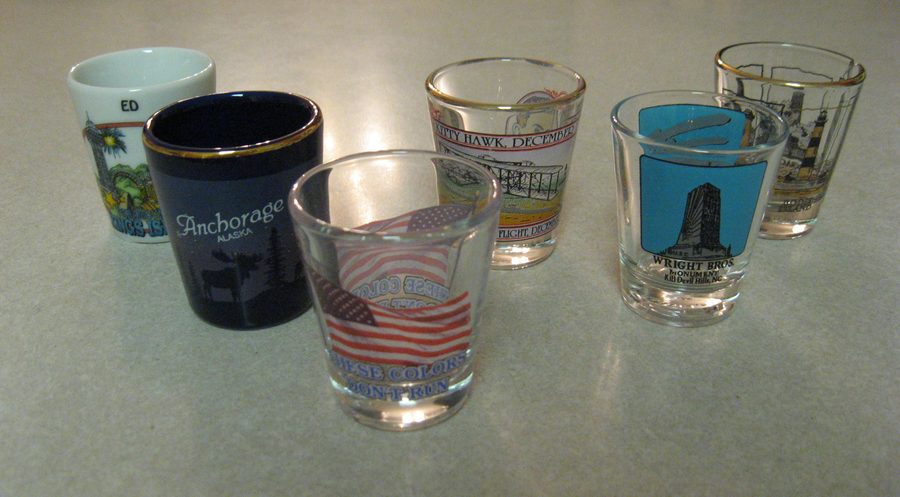
The 44ml US standard is the most globally recognised, largely through the spread of cocktail culture — Hollywood films, global bar culture, and bartending education programmes have all exported the American measure. Yet even within the United States there is no federal legal standard; some states use 1.25 fl oz (37ml).
Britain's dual standard reflects the complexity of pub culture. Scottish pubs commonly use 25ml, while many establishments in England and Wales use 35ml. Both are permitted under the Weights and Measures Act 1985.
Why Shot Glasses Have Thick Walls
Pick up a shot glass and you immediately notice the difference from a wine glass or whisky tumbler. The glass is thick. The base is especially heavy. The reasons are practical.
Impact resistance. Shot glasses are set down hard on bar counters. The American habit of drinking quickly and placing the glass down with a firm knock is widespread. Thin glass cannot withstand this impact repeatedly.
Grip and weight. A small vessel needs sufficient weight and thickness to hold securely. Too light and it slips from the fingers.
Visual illusion. A shot glass with a thick base appears fuller than it is. The actual volume is modest, but the glass looks satisfyingly full. Whether this effect is intentional design is unconfirmed.
The Shot Glass as a Measuring Tool
Beyond drinking, the shot glass has historically served as a measuring tool in cocktail bars. Before the jigger became standard, bartenders measured ingredients with shot glasses. Modern bars more commonly use the double-ended jigger with two capacities marked, but some bartenders still use graduated shot glasses for measurement.
The American "jigger" holds 1.5 fl oz; the smaller "pony" holds 1 fl oz. This ratio became the foundation of many classic cocktail recipes.
One-Shot Culture and Regional Differences
The practice of drinking spirits in a single gulp is particularly pronounced in Eastern Europe and East Asia. Russian and Eastern European vodka culture, Korean soju one-shot, and the Japanese ikki-nomi (一気飲み) are the most prominent examples.
In Western Europe — France and Italy especially — spirits are more commonly sipped slowly. Cognac and Armagnac are served in nosing glasses to be savoured over time.
This difference has shaped shot glass design. In cultures of quick consumption, thick, durable shot glasses developed. In cultures of aromatic appreciation, small liqueur glasses became more common.
The Shot Glass in Korea
In Korean drinking culture, the shot glass evolved independently in the form of the soju-jan (소주잔). Traditional soju cups were small vessels of white porcelain or ceramic, but from the twentieth century onward the glass soju cup became standard.
Today's standard Korean soju glass holds approximately 50–60ml — sized for a single swallow, matched to soju's ABV (16–25%) and the one-shot culture. With the recent growth of premium distilled soju, it has become more common to drink soju from whisky glasses or cognac glasses, treating the spirit as something to nose and sip rather than down in one.