Holding a wine glass up to the light is a gesture we take for granted. Historically, it was impossible for most of human history. From Rome through the Middle Ages, glass was opaque or coloured. Truly clear, transparent glass was a luxury — and even then, full of impurities and bubbles. The idea of seeing the colour of your drink through the vessel became widespread only from the seventeenth and eighteenth centuries onward. At the centre of that change was Bohemia.
Bohemia — The Heart of European Glass
Bohemia is the historical name for the western part of what is now the Czech Republic. The region had been a centre of glassmaking since the Middle Ages, for a straightforward geographical reason: three things essential to glassmaking — silica sand, wood for fuel, and potash from plant ash — were all abundant here.
From the thirteenth and fourteenth centuries, glasshouses grew throughout the forested regions of Bohemia. The glass they produced differed from Venetian glass in a fundamental way. Venetian glass was soda-lime glass, made using soda ash (natron). Bohemian glass was potash-lime glass, made using ash from beech trees rich in potassium.
Potash glass was harder than soda glass and had a higher refractive index. Crucially, it was far better suited to cutting. Soda glass tended to crack when cut; potash glass held its form when sharp geometric patterns were engraved into it.
Lead Crystal — George Ravenscroft
In 1674, in London, George Ravenscroft developed a glass incorporating lead oxide (PbO) into the silica. This was lead crystal.
Adding lead dramatically raises the glass's refractive index. It was clearer than Bohemian potash glass and refracted light more brilliantly. It was also easier to work: cutting and engraving were more precise than with potash glass.
Ravenscroft's lead crystal threatened both Venetian and Bohemian glass in the market. It spread rapidly in Britain, and by the eighteenth century Waterford in Ireland had become the leading centre of lead crystal production.
Bohemian glassmakers, to survive the competition, pushed their cutting techniques further. Their geometric cutting patterns engraved into potash glass — though less brilliant than lead crystal — carved out a distinct standing among European nobility.
How Clear Glass Changed Drinking Culture
This question sounds simple, but it matters. When wine could finally be poured into a transparent glass and observed — what actually changed?
Colour became a quality standard. The colour of wine reflects its degree of oxidation, ageing, and grape variety. The colour of beer shows the degree of malt roasting and fermentation. The colour of a spirit indicates the cask type and ageing period. Before clear glass became widespread, none of this information was visually accessible.
Tasting culture developed. Holding a glass up to the light or swirling it to observe the legs (viscosity) is impossible without a transparent vessel. It is not coincidental that European wine tasting culture became systematised in the seventeenth and eighteenth centuries precisely as clear glass became widely available.
The glass became the table standard. Medieval European nobility drank from silver and pewter cups. Glass was scarce; ordinary people used wood or ceramic vessels. From the eighteenth century onward, as the production cost of clear glass fell, glass vessels gradually became the standard at the table.
The Golden Age of Bohemian Cutting
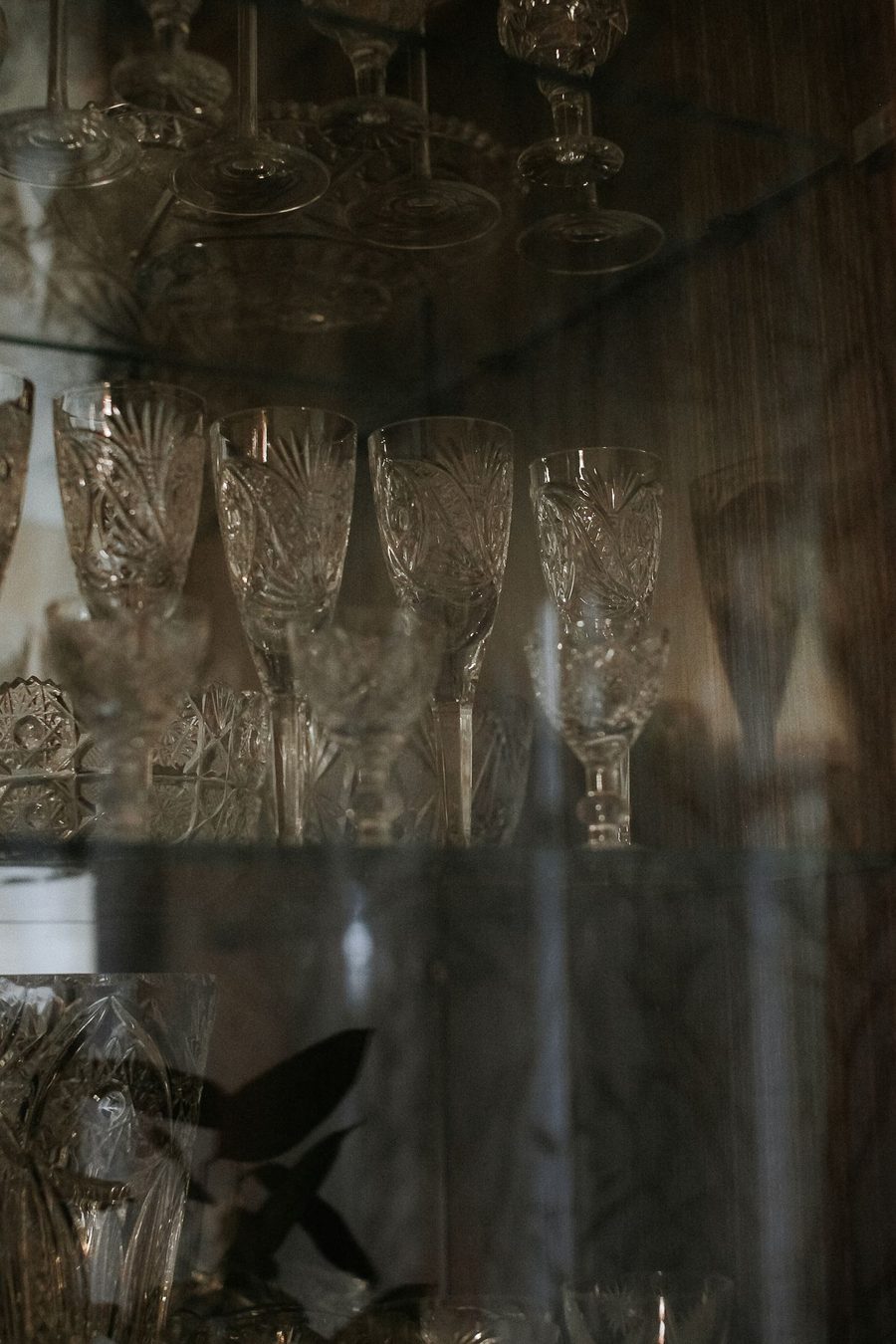
The eighteenth and nineteenth centuries were the height of Bohemian cut crystal. Glasshouses in Prague and across the Bohemian region produced top-tier tableware sets supplied to European royal courts and aristocracy.
The defining characteristic of Bohemian cutting is geometric precision. Diamond cutting, olive cutting, star cutting — engraving repeating patterns into the glass surface required skilled craftsmen and rotating abrasive tools. The more precise the pattern, the more directions light refracted, and the more brilliantly the glass caught the light.
This technique spread across Europe, and with nineteenth-century industrialisation, machine cutting brought prices down. Bohemian crystal moved from an exclusively royal possession to a middle-class household object.
Modern Lead-Free Crystal
In the latter half of the twentieth century, health concerns about lead crystal emerged. The worry was leaching — particularly when wine or whisky was stored for extended periods in lead crystal decanters, studies showed that lead could dissolve into the liquid.
In response, lead-free crystal was developed using barium oxide (BaO), zinc oxide (ZnO), or titanium oxide as substitutes. Modern crystal glass brands — Riedel, Spiegelau, Schott Zwiesel — almost all use lead-free crystal today. Lead-free crystal does not match the refractive index of lead crystal, but it offers greater durability and, in many cases, dishwasher compatibility — making crystal glassware practical for everyday use.
The Czech Glass Industry Today
The Czech Republic remains one of the world's major producers of crystal glass. Nový Bor and Karlovy Vary are home to concentrated clusters of glasshouses and museums. Handcrafted crystal is one of the Czech Republic's signature exports, and the government protects Bohemian glass as cultural heritage.
How Czech glasshouses survive against global crystal brands is through the precision of handcraft — irregular thickness variations that machines cannot replicate, cutting patterns engraved directly by craftsmen. The price is higher, but the difference in how the glass refracts light against a lamp is visible to the eye.
A single transparent glass changed drinking culture. Bohemia's glassmakers made that possible.