
Most wine glasses are big. The bowl swells out to gather the aroma and to widen the surface where the wine meets the air. The glass you pour icewine into, though, is conspicuously small — narrow at the mouth, short in height, not even half the size of an ordinary wine glass, and filled only a finger or two deep. Part of it is that the wine is expensive and you sip it sparingly, but the smallness has a clearer reason than that. And half of that reason lies in the Canadian winter.
Pressed from frozen grapes
Icewine is made by freezing the grapes. More precisely, the grapes are left unpicked, hanging on the vine, until they freeze. Once autumn has passed and deep winter drops the temperature well below freezing, the water inside each grape turns to ice while the sugar and acid stay unfrozen and concentrated. The frozen grapes are picked while still frozen and pressed before they thaw. The ice stays behind in the press, and only a few drops of thick, intense juice run out.
The yield is tiny. From grapes that would make a full bottle of ordinary wine, icewine yields only a small one. Birds, frost, or a sudden thaw can wipe out an entire year's crop. There is a reason it comes in little bottles and sells dear. And there is the first reason the glass is small — there was never much of it to begin with, and every mouthful is concentrated.

The small, narrow icewine glass. A single pour is around 50 millilitres, barely enough to cover the bottom. A small glass for a wine there is little of.
In Canada the rules are strict. The grapes must freeze naturally on the vine, and they may only be picked once the temperature has fallen to −8°C or below. That cold usually comes in the dead of night or before dawn. So the harvest becomes midwinter night work — people with flashlights picking frozen grapes by hand in a frozen vineyard.
Why Canada
Canada did not invent icewine. Germany did. There it is called Eiswein, and records of it survive from the late eighteenth and early nineteenth centuries. The origin stories tend to go that someone, unwilling to waste grapes that had frozen by accident, pressed them anyway — and the result was an unexpectedly sweet, intense wine.
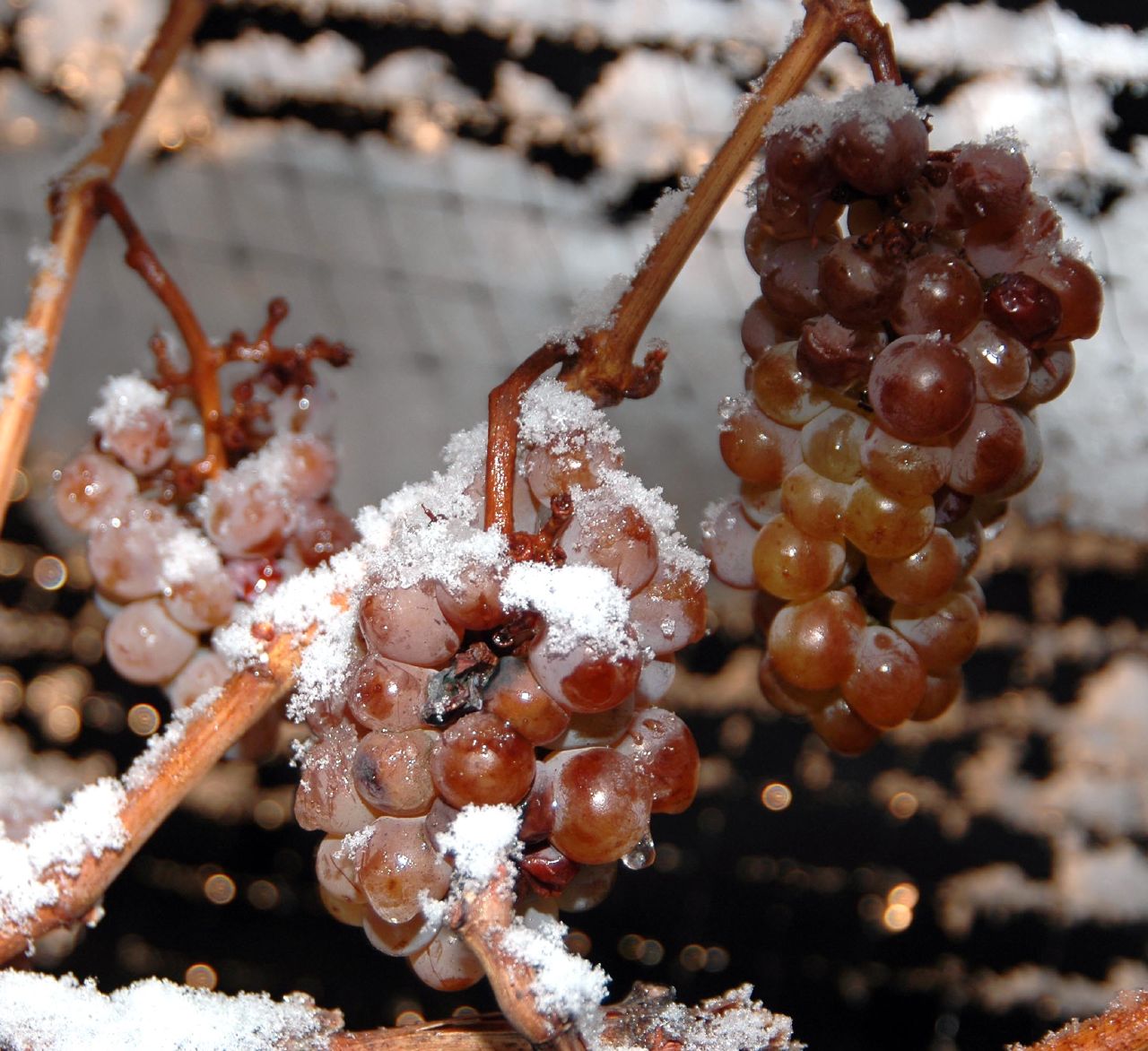
Grapes left to freeze on the vine into deep winter. The water inside turns to ice while only the sugar and acid concentrate. They must be picked in this state and pressed before they thaw.
Yet the country that now makes the most icewine in the world is Canada. The reason is simple: the cold is dependable. Icewine can only be made if the grapes freeze thoroughly on the vine — and do so almost every year. German winters no longer reliably turn that cold, and it is not rare for a year to pass without a single drop of Eiswein. The Niagara Peninsula in Ontario and the Okanagan Valley in British Columbia, on the other hand, plunge well below −8°C almost every winter. Where freezing grapes is concerned, the Canadian winter can be trusted.
The decisive moment came in 1991, when Inniskillin of Ontario won a top prize for its 1989 Vidal Icewine at Vinexpo, the wine fair in Bordeaux, France. It put the name of a young wine country on the world map. Earlier still, in the 1970s, Walter Hainle had made the first commercial Canadian icewine in British Columbia. The wine began in Germany, but it was a colder country that made it its own.
That the grape called Vidal became the workhorse of Canadian icewine also has to do with the cold. It is a thick-skinned, cold-hardy hybrid that holds up well while hanging frozen on the vine into deep winter. Riesling is used too, and Cabernet Franc makes a red icewine, but for surviving the frozen nights, Vidal was the right fit.
The shape of the glass
The icewine glass is small and narrow. It looks like a shrunk-down white-wine glass, with a slender bowl that tapers in slightly at the mouth. There are a few calculations behind that shape.
First, the volume. Icewine is poured about 50 millilitres at a time, barely enough to cover the bottom of the glass. Pour that into a large glass and the wine lies in a thin film at the base, looking meagre, with the aroma scattered. A small glass holds a small pour properly.
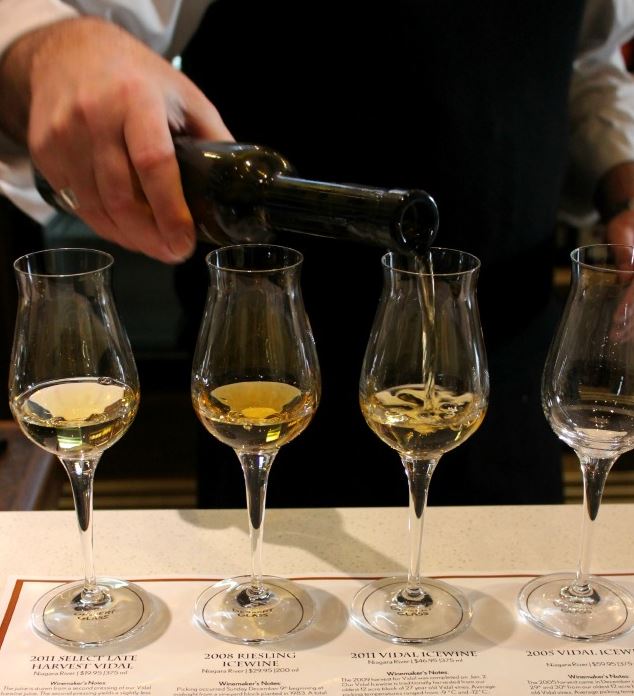
A tasting flight of icewine poured into small tulip glasses (Niagara). Because the glasses are small and narrow, even a little wine doesn't look meagre and the strong aroma gathers upward.
Next, the temperature. Icewine is drunk cold, usually around 10°C. With a small glass you finish the pour before your hand and the air warm it. Pour a lot into a big glass and hold it a while, and it turns lukewarm in the meantime.
Last, the balance of aroma and taste. A slender bowl that narrows at the mouth gathers the strong aroma upward. Icewine smells intensely of things like apricot, peach, and honey, and the narrow rim keeps that from dissipating. The tapered mouth also narrows how much reaches your lips at once and the direction it lands, so the strong sweetness doesn't pour in all at once. Icewine is sweet but also high in acidity, and the balance between the two is everything. When makers like Riedel put out a dedicated icewine glass, it is an attempt to tune that balance through the shape of the glass.
How to drink it
The rules are not complicated. Chill it, and pour just a little into a small glass. Drink it slowly after a meal alongside dessert, or as the dessert itself. It is often paired with salty, rich things like foie gras or blue cheese, where the sweetness and the saltiness lift each other. Serve it cold, but not too cold — chilled too far, the aroma and the sweetness close up.
An opened bottle, re-stoppered and kept in the fridge, will last several days. Its high sugar and acid carry it longer than ordinary wine.
What the small glass holds
Follow the reasons the icewine glass is small and you end up at the Canadian winter. To freeze grapes on the vine, press them while frozen, and gather the little that yields to drink it cold — for all of that, the glass grew small. If a large glass is made to spread the aroma out, this small one is made to hold a precious mouthful together so it doesn't scatter. A wine another country started, a colder one took up and made its own — and that whole story sits in a single matter of size.
Glass of icewine — Biskuit / Wikimedia Commons (CC BY-SA 2.0) · Frozen grapes on the vine — Dominic Rivard / Wikimedia Commons (CC BY-SA 2.0)